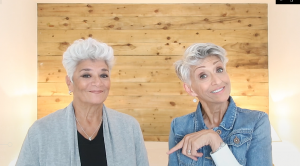
With the whole world focused on COVID-19, it’s not surprising that cardiovascular diseases have been relegated to the back burner this year. Yet they are the world’s biggest killer, responsible for almost 18 million deaths annually, 85% of which are due to heart attack and stroke. My eldest sister Loraine could have been one of those statistics when, in 2013, she suffered a cardiac arrest. Luckily, a defibrillator was on hand, and she’s lived to tell the tale of how she did everything necessary to bring on a heart attack and why she’s doing everything it takes to make sure it never happens again.
First, you need to know our back story. Our parents died young, mum was only 50 and dad 58. Where mum was slim and active, dad weighed 25 stone and had a dodgy knee; both were smokers and had high cholesterol. They were very much of the school of ‘do as I say, not as I do’ and always told us smoking was a terrible habit and we must never smoke. Three of the four sisters followed orders, but Loraine started smoking secretly at 16, only one or two a week at first then, once she started work, it was a 20-a-day-habit. We didn’t know it then, but we four kids had inherited a predisposition to heart disease and ‘familial cholesterol’. ‘Familial cholesterol’ is a gene mutation that prevents some of us from processing cholesterol (a type of fat) efficiently, leading to clogged blood vessels. All we needed to do to ignite this potentially toxic mix of conditions was to light up. And that’s what Loraine did at 16. Despite all the scientific evidence, there was no way she could give up smoking. ‘It’s an addiction,’ she told me recently. ‘I could watch a programme on lung cancer while chain smoking.’ She wasn’t in denial, she just enjoyed smoking.
In the late 90s Loraine managed to quit for seven years, but in 2004, when she moved from England to Gibraltar to be near our sister Lesley, and was enjoying a very full social life, smoking drew her back in. Nine years later, after breaking up a fight at a wake (she may only be 5’ 2” but she’s feisty), she felt a little breathless and told Lesley she didn’t feel too well. Lesley admits, even now, that not once did she think Loraine was actually ill, she just though she was being dramatic and decided to call her bluff by driving her to A&E. Lesley left Loraine in the reception area while she re-parked the car. By the time she returned, Loraine had collapsed, her heart had stopped beating and she was undergoing emergency treatment to save her life. She had literally been in the right place at the right time. The doctors got her heart beating again and, three stents later, she was able to walk back to her flat and carry on (not quite) as normal.
‘I realise that I had probably had heart disease for at least a couple of years before the heart attack, but I’d put the symptoms down to ageing,’ says Loraine. ‘I was always feeling tired. I’d always be breathless, and usually break into a sweat just going shopping or climbing the stairs to my flat. I thought it was normal. But after the operation to insert the stents into my arteries, all physical activities became so much easier. I could breathe again.’
A week before her cardiac arrest Loraine remembers feeling unable to get comfortable. It was as though a band was tightening around her chest, and the pain was radiating upwards. She went to bed, kept changing positions to try and relieve the pain, had a hot shower, but nothing worked. After a couple of hours, the pain subsided. The doctors believe she was having a heart attack then.
The genes weren’t on her side
After the operation, Loraine attended a 13-week rehabilitation course. The importance of regular exercise and healthy meals was impressed on her and, although it’s stuff most of us know, it’s taken far more seriously by those who’ve had a near-death experience. And, of course, Loraine stopped smoking immediately. She didn’t vape or chew nicotine gum either, she just quit doing her very favourite thing. She’d realised that, while her lifestyle in Gibraltar was a healthy one (not the smoking bit) – plenty of outdoor activities and a Mediterranean diet – our parents had passed on certain conditions that make a heart attack a cert if appropriate action isn’t taken. They both died of heart disease, so all four of us were more susceptible to it, and we all have high cholesterol. So, in addition to ditching the smoking habit (obviously not inherited), and in 2016 becoming tea-total (not that she was a big drinker), Loraine’s taking statins to control her cholesterol, something she’ll have to do for the rest of her very healthy life.
Loraine moved to Tendring this September and is regularly putting me to shame with her energy and zest for life. ‘Ever since the operation I’ve been feeling better and better, and I’m doing everything in my power to ensure I never have a heart attack again.’
So, just how healthy are we?
We all know we need to take care of ourselves, physically and mentally, if we’re to enjoy a long and happy life. None of us wants to be a burden on our relatives or the NHS and, let’s face it, we don’t want to go into a home if we can help it. So, we’re eating healthily, exercising regularly, cutting down on alcohol and we’re not smoking . Well, I guess you can already see the glaring discrepancies in that last sentence. Sadly, as far as looking after ourselves goes, we’re not that great. Every year Bloomberg conducts global research to track the healthiest nations, and in 2020, we came 19th. Spain’s at the top, boasting a life expectancy of 83.5 years, projected to increase to 85.8 by 2040, the highest in the world. But don’t the Spanish drink a lot of wine, smoke and stay up late? Well, yes they do, but Spain also has the highest percentage of walkers with almost 40% of the population walking everywhere they can; they also follow a Mediterranean diet which is high in healthy fats, vegetables and legumes, and low in processed food and red meat. Spain is followed by Iceland, Japan, Switzerland, Sweden, Australia, Singapore, Norway and Israel. The USA doesn’t even make it into the top 30 (it’s 35th) due to its obesity levels.
The UK and heart disease
- 4 million people living with cardiovascular diseases(CVDs)
- Around twice as many people are living with CVDs than cancer and Alzheimer’s disease combined
- 27% (170,000) of all deaths are due to CVDs
- Around 44,000 people under the age of 75 die from heart and circulatory diseases each year
Source: British Heart Foundation, July 2020


Leave a Reply
You must be logged in to post a comment.